
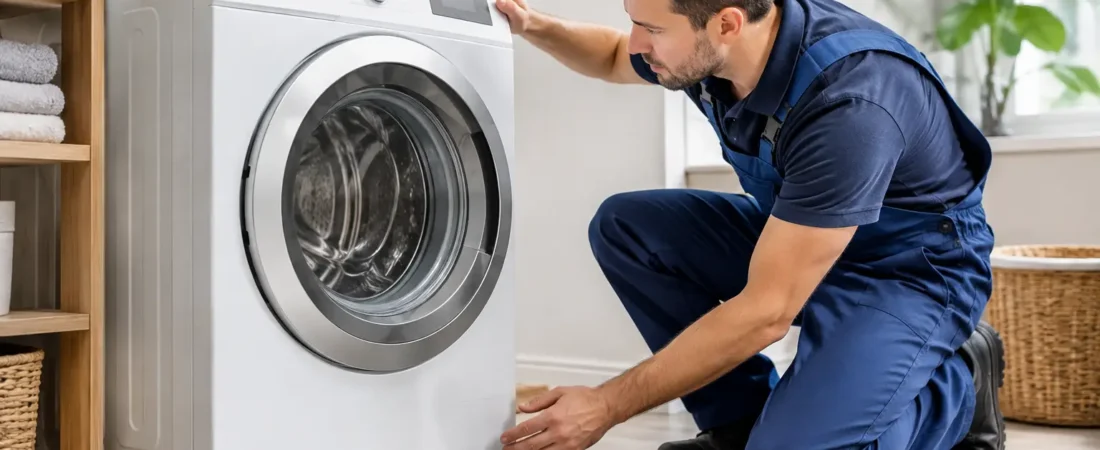
A washer that walks across the laundry room, bangs during spin, or shakes a nearby wall is not just annoying. Repeated vibration can loosen hose connections, damage flooring, strain internal suspension parts, and eventually lead to a larger repair. Learning how to fix washer vibration starts with separating normal high-speed spin movement from vibration that signals an installation, loading, or mechanical problem.
Most homeowners can safely check a few common causes before scheduling service. If the washer is violently shaking, leaking, showing an error code, or making metal-on-metal noises, stop the cycle and avoid running it again until the cause is identified.
Start with the floor and washer position
A washing machine needs a firm, level surface. Even a small amount of rocking can become dramatic when a heavy, wet load reaches high spin speed. Place your hands on opposite top corners of the washer and press down firmly. If it rocks, the leveling feet need attention.
Adjust the feet one at a time until all four make solid contact with the floor. Many washers have locking nuts above the feet. Once the machine is level, tighten those nuts against the cabinet so vibration does not gradually change the adjustment. A standard bubble level is useful, but the no-rock test matters just as much.
Do not rely on thick rubber pads to correct an unlevel washer. Anti-vibration pads can reduce minor noise on a hard floor, but they cannot solve a badly uneven machine, a soft floor, or failing internal components. In fact, excessively soft pads may let some washers move more.
Floor construction matters, particularly in upstairs laundry rooms, older homes, and condominium units. A wood floor with noticeable flex can amplify a washer’s normal spin vibration. A front-load washer, which spins at much higher speeds than many top-load models, can make that movement especially apparent. Leveling the washer is still necessary, but a flexible floor may need evaluation by a building professional if severe vibration continues.
Check the load before assuming the washer is broken
An unbalanced load is the most common reason a washer suddenly begins pounding during one cycle but seems normal during the next. Heavy items such as bath mats, comforters, towels, jeans, and blankets can collect on one side of the drum. When that happens, the machine may stop and rebalance itself, spin poorly, or shake hard enough to walk forward.
Pause the cycle if the washer allows it, redistribute the items around the drum, and restart the spin. Wash a single large item with a few similar items to help distribute weight. For example, add several towels when washing a comforter rather than washing the comforter alone.
Overloading causes problems too. A packed drum prevents clothing from moving freely, making it harder for the washer to balance the load. Underloading can be just as troublesome with bulky items. Follow the load-size guidance in the washer manual, especially with high-efficiency front-load models from LG, Samsung, Bosch, Miele, Whirlpool, and other brands that use sophisticated out-of-balance sensing.
Remove shipping bolts on a newly installed washer
If vibration started immediately after a new washer was installed or moved, check for shipping bolts. Front-load washers are commonly secured with bolts at the rear of the cabinet to prevent the tub from moving during transport. Those bolts must be removed before operation.
A washer run with shipping bolts installed can shake violently and may suffer internal damage. The bolts are usually obvious at the back panel, but the number and appearance vary by brand and model. Do not guess or remove unrelated screws. Refer to the installation instructions for the specific model, or have the installation checked by a qualified technician.
This issue also comes up after a move. Keep shipping bolts in a labeled bag and reinstall them whenever a front-load washer is transported.
Inspect hoses, drain connections, and nearby contact points
Sometimes the sound described as vibration is actually a washer striking something beside or behind it. Pull the machine forward slightly, if it is safe to do so, and inspect the area. The drain hose, water supply hoses, power cord, and dryer vent behind a nearby dryer should not be trapped beneath the washer or pressed tightly against the cabinet.
Leave enough room behind the machine for hoses to bend naturally without kinking. Check that the drain hose is properly secured in the standpipe as well. A loose hose can slap against the wall or pipe during draining and spinning.
Also look for a cabinet that is rubbing against a counter, wall, pedestal, or laundry-room door. A washer needs a small amount of clearance on all sides. Pushing it tightly into a closet may make normal movement sound much worse than it is.
How to fix washer vibration caused by worn parts
If the washer is level, properly installed, and consistently balanced but still shakes, internal components may be worn. This is where the sound and timing of the vibration provide useful clues.
A front-load washer that thumps heavily during spin, even with a small balanced load, may have worn shock absorbers, suspension springs, or counterweight mounting problems. The tub may feel unusually loose when pushed by hand through the door opening. A damaged shock absorber does not always create a constant noise, but it allows too much tub movement once the spin cycle begins.
On top-load washers, worn suspension rods or tub support components can cause the basket to lean, bounce excessively, or strike the cabinet. Older machines may also develop worn snubber pads or suspension springs. These parts can be replaced, but diagnosis should be accurate because several failures can produce similar symptoms.
A loud rumbling, grinding, or roaring noise that increases with spin speed can point to failed tub bearings. On some washers, bearing repair is labor-intensive and may require major disassembly of the outer tub. Water stains, rust-colored residue below the washer, or play in the inner basket can support that diagnosis, but they are not proof on their own.
Loose counterweights are another serious possibility on many front-load washers. Counterweights help stabilize the tub at high speeds. If a mounting bolt loosens or a concrete weight cracks, the machine can bang sharply during spin. Do not continue using the washer if you suspect this problem. A loose counterweight can damage the cabinet, tub, or surrounding area.
When a professional washer repair is the safer choice
Basic leveling and load adjustments are appropriate homeowner tasks. Internal repairs are different because washers contain heavy moving assemblies, electrical connections, sharp cabinet edges, and water lines. Unplugging the appliance before inspection is essential, and shutting off the water supply is wise if the washer must be moved.
Schedule professional service when the washer shakes with nearly every load after being leveled, when the basket appears off-center, or when vibration is paired with grinding, banging, leaks, burning smells, or error codes. It is also wise to call for service if a stacked washer and dryer unit is moving. These installations have additional stability and mounting considerations.
For homeowners and property managers in Miami-Dade and Broward County, King Appliances can diagnose whether the problem is related to installation, suspension, bearings, a damaged tub assembly, or another component. A proper diagnosis helps avoid replacing parts that are not actually causing the vibration.
Prevent vibration from returning
Once the washer is stable, a few habits can reduce future problems. Check the machine for rocking after flooring work, a move, or any time it has been pulled out for cleaning. Avoid repeatedly washing one oversized item by itself, and do not force an extra load into the drum. Clean beneath and behind the washer periodically so debris does not interfere with its feet or hoses.
Pay attention when the sound changes. A washer that has always produced a mild, even spin sound but suddenly begins banging is giving you useful information. Addressing that change early is usually easier on the appliance, the laundry room, and the people living below an upstairs unit.