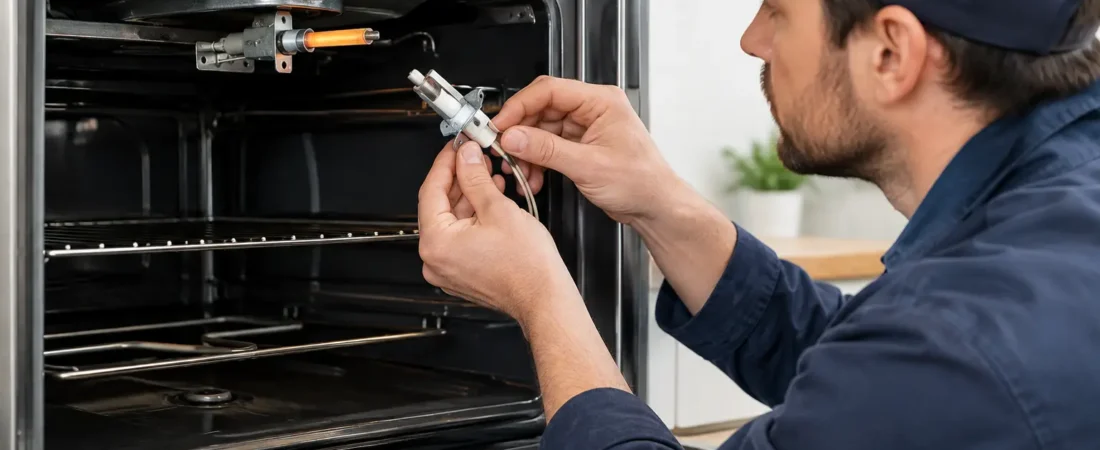
A Wolf oven that clicks, glows orange, or seems to start normally but never reaches baking temperature often points to an ignition problem. A Wolf oven igniter replacement may be the correct repair, but it should follow a proper diagnosis. A weak igniter can look functional to the eye while still failing to draw enough electrical current to open the gas safety valve.
That distinction matters with premium appliances. Replacing the wrong part can leave the original problem unresolved, create repeat service calls, and put unnecessary stress on components that are not inexpensive.
What an oven igniter actually does
On a gas Wolf oven, the bake or broil igniter heats up when the selected cooking function is started. Most use a hot-surface igniter, sometimes called a glow-bar igniter. As it becomes hot, it draws electrical current through the circuit. Once the required current is reached, the oven safety valve opens and allows gas to flow to the burner, where the hot igniter lights it.
The igniter therefore does two jobs: it creates the heat needed for ignition and helps trigger the gas valve. When it weakens, it may still glow bright orange but fail to open the valve reliably. The result may be no flame, delayed ignition, or an oven that takes far too long to preheat.
Not every Wolf oven has a replaceable gas igniter. Electric ovens use heating elements and other controls rather than a gas ignition system. Wolf product configurations vary, so the model number and the exact symptom should be confirmed before a part is ordered.
Signs a Wolf oven igniter replacement may be needed
The most common complaint is simple: the oven will not heat, even though the display appears normal and the controls accept the temperature setting. On a gas model, you may hear a relay click and see an igniter glow, but the burner never lights.
Slow preheating is another frequent sign. If a Wolf gas oven once reached 350 degrees in a normal amount of time but now needs an unusually long period, the igniter may be losing strength. It may eventually light the burner, but only after a delay. Because the oven cycles repeatedly during cooking, that delay can also lead to poor temperature stability and uneven results.
Other warning signs include a burner that lights only intermittently, a strong gas odor without ignition, or ignition that is delayed enough to produce a small “whoosh” when the burner finally lights. A gas odor should never be treated as a routine appliance issue. Turn the oven off, avoid operating electrical switches or creating a flame nearby, ventilate the area if it can be done safely, and contact the appropriate gas utility or qualified service professional.
A glowing igniter does not prove the igniter is good. This is one of the most common sources of confusion for homeowners. Glow is visible; the correct electrical current is not.
Why the igniter is not always the cause
An oven that will not heat can have several causes. The bake burner itself may be blocked or damaged. The gas safety valve may be defective. Wiring connections can become heat-damaged over time, and an electronic control or relay may not be sending power consistently. On models with separate bake and broil functions, the symptom pattern can help narrow the diagnosis.
For example, if broil works normally but bake does not, the bake igniter, bake burner circuit, or bake valve path deserves closer attention. If neither bake nor broil works, a shared power supply, control issue, gas supply issue, or safety component may be more likely. These patterns are useful clues, not final proof.
A technician typically verifies the model information, observes the ignition sequence, checks the igniter’s electrical performance, inspects the burner and wiring, and confirms whether the gas valve is responding correctly. This process is more reliable than replacing a part based solely on how bright it looks.
Wolf oven igniter replacement: repair or replacement?
In many cases, replacing a weak igniter is a practical repair. Igniters are wear items because they heat to extremely high temperatures every time the oven operates. A correctly matched replacement can restore normal ignition and preheat performance without replacing larger assemblies.
The decision becomes less straightforward when an oven has multiple issues. If the igniter is weak but the burner is badly corroded, wiring is heat-damaged, or the control is also failing, the full repair scope should be considered before work begins. Age alone does not decide whether a Wolf oven is worth repairing. Overall condition, service history, availability of model-specific parts, and the number of active faults matter more.
For a built-in unit or a range installed in a tight kitchen opening, access can add complexity. Panels may need to be removed, and the appliance must be handled carefully to prevent damage to cabinetry, flooring, gas connections, or electrical wiring. Premium appliances also often have model-specific igniters and mounting arrangements. A part that resembles the original is not necessarily the right electrical or physical match.
Why this repair is often best left to a professional
Some homeowners are comfortable with basic appliance maintenance, but gas oven ignition repairs involve live electrical circuits, fragile components, sharp sheet-metal edges, and a gas fuel system. The work should begin only after the appliance is disconnected from electrical power and the gas supply is shut off. The system must then be reassembled correctly and tested for proper ignition and safe burner operation.
Installing an incompatible igniter can create slow ignition, repeated part failure, or damage to the gas valve. Handling the ceramic portion of a new hot-surface igniter with bare fingers can also shorten its life, since residues may create hot spots when the part heats up.
Professional service is especially appropriate if there is any gas smell, repeated delayed ignition, visible wire damage, a tripped breaker, or uncertainty about the oven model. A qualified technician can determine whether the igniter is actually the failed component instead of treating replacement as a guess.
Practical steps before scheduling service
There are a few observations that can help make a service visit more efficient. Record whether the issue occurs in bake, broil, or both. Note whether the igniter glows, whether the burner lights eventually, and approximately how long preheating takes. If the oven display shows an error code, write it down exactly.
Also locate the appliance model number. On many ovens and ranges, it is found on the frame around the oven opening, behind the door, or in the product documentation. Do not disassemble panels or attempt to test live voltage to obtain it. A clear description and the correct model number help ensure the technician arrives prepared for the appliance configuration.
Avoid repeatedly cycling an oven that is showing delayed ignition or giving off a gas odor. Repeated attempts do not strengthen a failing igniter, and they can make the situation less predictable.
Maintenance that supports reliable ignition
An igniter will eventually wear out, but careful oven use can reduce avoidable trouble. Keep the oven interior reasonably clean, especially near burner openings. Heavy spillovers, foil placed in ways that block airflow, and aggressive cleaning around components can interfere with burner performance.
Use the self-clean cycle according to the Wolf manual and with realistic expectations. Self-cleaning exposes the oven to very high heat, which can stress igniters, sensors, control boards, and other aging components. It is not automatically harmful, but an oven already showing intermittent heating or electronic issues should be evaluated before running a long self-clean cycle.
In South Florida, humidity and periods of seasonal vacancy can also affect appliance condition. If a home is unoccupied for part of the year, having major appliances checked when returning can identify issues before a holiday meal or a guest stay depends on the oven.
When to call for Wolf oven service
A gas oven that will not light, preheats slowly, or produces delayed ignition deserves timely attention. The repair may be limited to an igniter, but diagnosis protects against overlooking a faulty valve, wiring issue, or control problem. For homeowners in Miami-Dade and Broward County, King Appliances can evaluate Wolf oven heating and ignition complaints with the model-specific approach premium equipment requires.
If your oven is taking longer to heat than it used to, treat that change as useful information rather than a minor inconvenience. Addressing it early can help keep a small ignition issue from interrupting cooking when the oven is needed most.