
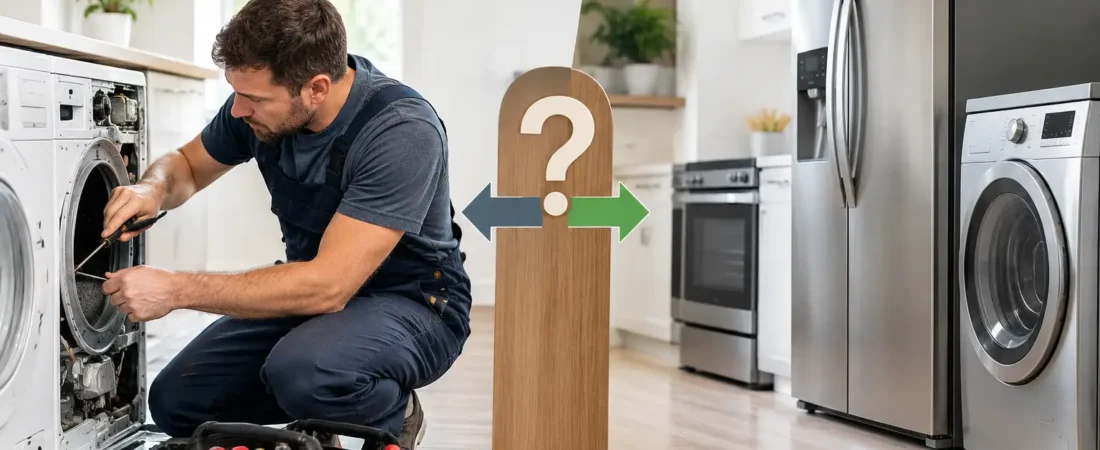
A refrigerator that stops cooling before a weekend, a washer that will not drain, or a dishwasher leaving dishes dirty can force a quick decision. The repair versus replace appliances question is rarely answered by price alone. The right choice depends on the specific failed part, the appliance’s age and condition, the cost and availability of parts, and how the unit has performed over time.
For South Florida homeowners, the decision can be more complicated by high humidity, hard-water mineral buildup, storm-related power interruptions, and the needs of seasonal or rental properties. A clear diagnosis comes first. Replacing an appliance without identifying the actual problem can mean spending thousands of dollars to solve what may have been a repairable issue.
Repair Versus Replace Appliances: Start With the Failure
Not every appliance failure has the same significance. A dishwasher with a worn door seal is very different from one with a damaged tub or repeated electronic control failures. A dryer that does not heat may need a heating element, thermostat, or vent correction. Those are often practical repairs. A dryer with a failing motor, damaged drum supports, and a rusted cabinet is a different calculation.
The most useful first question is not, “How old is it?” It is, “What failed, and what else is likely to fail soon?” A professional diagnosis should identify the failed component, explain whether the repair addresses the root cause, and flag related wear when it is visible. This gives you a realistic repair decision rather than a guess based on an error code or symptom alone.
A single, isolated part failure in an otherwise dependable appliance often supports repair. Multiple failures, recurring leaks, major structural damage, or unavailable parts can shift the balance toward replacement.
Compare the Full Cost, Not Just Today’s Repair Bill
Homeowners often hear a version of the 50 percent rule: replace the appliance if a repair costs more than half the price of a new unit. It can be a useful starting point, but it is not a universal rule.
A new appliance price may not include delivery, installation, removal of the old unit, new hoses or electrical work, cabinetry adjustments, or downtime while waiting for a suitable model. For built-in refrigerators, panel-ready dishwashers, wall ovens, cooktops, and premium appliances, replacement can involve substantially more than the cost listed on a sales floor.
On the other hand, a repair that is inexpensive only makes sense if it is likely to provide meaningful additional service. Spending a modest amount to repair a 14-year-old refrigerator that has already had compressor, fan, and control board problems may simply postpone a larger expense. The repair may still be reasonable for a rental property, a seasonal home, or a short-term situation, but the trade-off should be clear.
Consider these four costs together before deciding:
- The diagnosed repair, including labor and any necessary follow-up parts
- The expected remaining useful life after the repair
- Replacement and installation costs, including any fit or utility changes
- The cost of failure, such as food loss from a refrigerator or water damage from a washer
The last point matters more than many people expect. A washer with an active leak or a refrigerator that is not holding safe temperatures should not be left in service while the decision is delayed.
Age Matters, but Condition Matters More
Major appliances do not have a fixed expiration date. Usage, installation quality, maintenance, model design, and prior repairs all affect longevity. A well-maintained appliance can outlast its average expected service life, while a poorly ventilated refrigerator or an overloaded washer can fail early.
As a general range, refrigerators may serve for 10 to 15 years, washers and dryers for roughly 10 to 13 years, dishwashers for about 9 to 12 years, and ranges or cooktops for 13 to 15 years or longer. These are broad estimates, not guarantees. Premium brands such as Sub-Zero, Miele, Wolf, Thermador, Viking, and Liebherr may justify repair at an older age because their replacement costs are higher and certain models are designed for long-term service.
A newer appliance is not automatically the better repair candidate, either. Some modern units use electronic boards, sensors, inverter systems, and specialized components that can be expensive or delayed in supply. If a part is unavailable or discontinued, replacement may be the only practical option even when the appliance is not old.
When Repair Is Usually the Better Call
Repair is often sensible when the appliance has been reliable, the issue is isolated, and the repaired unit should have several useful years ahead. Common examples include a refrigerator with a failed evaporator fan motor, a dishwasher with a worn pump or inlet valve, or a washer with a damaged drain pump.
Dryer problems deserve particular care. A dryer that takes too long to dry may have a failed heating component, but it may also have a restricted vent. Replacing the dryer without correcting the vent can leave the same drying problem in place and create an avoidable fire risk. The appliance is not always the source of the symptom.
Repair can also be the more practical option when replacing the appliance would create a fit problem. Many condominiums in Aventura, Sunny Isles Beach, Hollywood, and Fort Lauderdale have tight laundry closets, custom kitchen openings, or elevator and delivery constraints. A replacement unit may require careful measurements, door-clearance planning, or modifications that make a sound repair especially worthwhile.
When Replacement Makes More Sense
Replacement is generally worth serious consideration when the appliance has several expensive failures, corrosion or cabinet damage, a cracked tub, a sealed-system refrigerator failure on an older basic model, or a part that is no longer available. Repeated service calls are also a meaningful signal. One repair does not make an appliance unreliable, but a pattern of unrelated failures often does.
Energy and water use can factor into the decision, especially for older refrigerators, washers, and dishwashers. A newer unit may reduce operating costs, though the savings should be considered realistically rather than assumed to offset a replacement quickly. The greater benefit may be improved capacity, quieter operation, better leak protection, or features that suit the household better.
Replacement can also be the safer route if an appliance cannot operate reliably. Refrigerators that cannot maintain safe food temperatures, gas cooking appliances with ignition or burner problems, and washers with repeated leaks deserve prompt professional attention. Do not continue using equipment that creates a safety risk simply because it still runs some of the time.
South Florida Conditions Can Change the Decision
Heat and humidity place extra demands on refrigeration equipment. Refrigerators need proper airflow around the cabinet and clean condenser areas where applicable. Dust buildup, pet hair, and restricted ventilation can make compressors work harder, especially in warm kitchens, garages, or utility rooms.
Water quality is another local consideration. Mineral deposits can affect dishwasher inlet valves, ice makers, water dispensers, and washing machine components. Small leaks can become costly quickly in condominiums, where water can affect neighboring units. An appliance with a minor but recurring leak should be assessed before it damages flooring, cabinetry, or ceilings below.
Seasonal residents should also think about what happens when a home sits vacant. Shutting off water supplies to washers and ice makers when appropriate, cleaning refrigerator seals, and avoiding overloaded circuits can reduce the chance of finding a preventable problem after months away.
Make the Decision With Useful Information
Before authorizing either path, ask for the diagnosed cause of the problem, the recommended repair, the estimated cost, and whether the technician sees other concerns that may affect reliability. Ask whether the part is available and how long the appliance would reasonably be expected to last after the repair. These answers are more useful than a simple yes-or-no recommendation.
For premium, built-in, or hard-to-replace equipment, a repair assessment is especially valuable. King Appliances regularly sees appliances where a targeted repair is far more sensible than replacing a unit that is integrated into cabinetry or still mechanically sound. For older standard appliances with multiple problems, the same evaluation may point clearly toward replacement.
The best decision is the one that fits the appliance’s actual condition, your budget, and the disruption a future failure could cause. A careful diagnosis today can prevent a rushed, expensive choice later.