
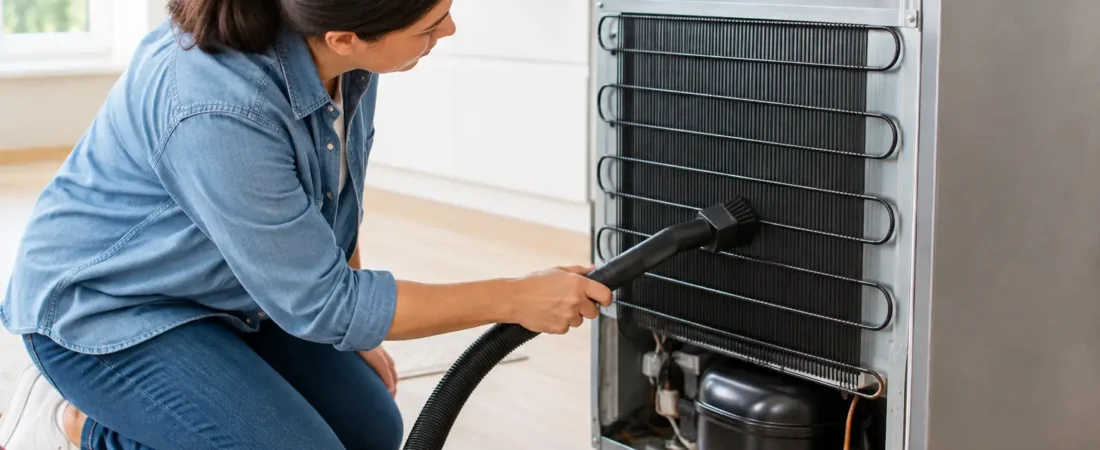
A refrigerator can still feel cold inside while its condenser area is working harder than it should. That is why homeowners often ask how often to clean refrigerator coils only after noticing a warm kitchen, longer run times, higher utility use, or a compressor that seems unusually hot. Coil cleaning is simple preventive maintenance in many homes, but the right schedule depends on the refrigerator design and the conditions around it.
How Often to Clean Refrigerator Coils
For most households, cleaning accessible refrigerator coils once every 6 to 12 months is a sensible starting point. Homes with shedding pets, frequent cooking, dust from nearby construction, or a refrigerator in a tight, poorly ventilated space may need attention every 3 to 6 months.
There is no single schedule that fits every appliance. Some newer refrigerators use a condenser design that is enclosed, tucked beneath the cabinet, or intended to need little routine cleaning. The owner’s manual for the specific model should take priority over general advice. If the manual says not to remove a panel or brush a particular area, follow that instruction.
In South Florida, air conditioning systems run for much of the year, and fine household dust can build up steadily. Beach-area homes may also see more airborne debris when windows and doors are opened regularly. Humidity itself does not coat coils with lint, but dust, pet hair, and kitchen grease can combine into a dense layer that restricts airflow around the condenser.
Why Clean Coils Matter
The condenser is where the refrigerator releases heat removed from the fresh-food and freezer compartments. When airflow through that area is restricted, the sealed refrigeration system may have to run longer to shed the same amount of heat. A dirty coil or condenser compartment can contribute to poor efficiency and excess heat around the machine.
That said, dirty coils are not the answer to every cooling complaint. A refrigerator that is warm, frosting heavily, cycling incorrectly, clicking, leaking, or showing an error code may have a fan, defrost, door-seal, control, compressor, or sealed-system problem. Cleaning is worthwhile maintenance, but it cannot repair a failed component.
If temperatures are already unsafe for food storage, move perishable food to another refrigerator or a cooler with ice while the issue is evaluated. The refrigerator compartment should generally stay at or below 40 degrees F, and the freezer should stay at 0 degrees F.
Signs Your Refrigerator Coils Need Attention
The most reliable sign is visible buildup on accessible coils, vents, the condenser fan area, or the lower grille. A thin film of dust is normal. Thick lint, pet hair, or greasy debris deserves cleaning.
Other clues can point to restricted airflow, although they do not prove the coils are the cause. The refrigerator may run for long periods, the floor or cabinet area near the compressor may feel hotter than usual, or the unit may seem louder because its fan and compressor are operating more often. On a refrigerator with coils underneath, a flashlight may reveal buildup through the front toe grille or rear access area.
Do not judge the condition by touching copper tubing or the compressor. These parts can be very hot during normal operation. Also, avoid bending tubing or moving the refrigerator so aggressively that a water line, drain line, or power cord is damaged.
Finding the Coils on Your Refrigerator
Older refrigerator models commonly have exposed coils on the back of the cabinet. Many modern refrigerators place the condenser underneath, behind the front toe grille, near the rear, or inside a lower machine compartment. A condenser fan often pulls room air through this area.
Some premium built-in refrigerators, including certain Sub-Zero models, have airflow screens, grilles, or condenser areas that are more accessible from the front. Others require a specific cleaning approach to avoid damaging panels, wiring, or fan blades. Built-in units should never be pulled out casually. Their installation, water connections, cabinetry clearances, and weight can make access difficult.
Before removing any grille or panel, confirm the location and procedure in the use and care manual. If you cannot identify the condenser safely, it is better to stop than to force a cover that was not designed for routine removal.
How to Clean Refrigerator Coils Safely
Start by protecting the appliance and the surrounding floor. Unplug the refrigerator if you can access the plug safely. If it cannot be moved without straining a water line or damaging flooring, switch off power at the appropriate breaker only if you are confident you have identified the correct circuit. Keep refrigerator and freezer doors closed during the process to retain cold air.
For most accessible condensers, you need a flashlight, a refrigerator coil brush, a vacuum with a narrow crevice attachment, and a soft dry cloth. A brush designed for appliance coils is flexible enough to reach between fins without excessive force.
Remove the toe grille or rear access panel only as directed by the manufacturer. Vacuum loose debris first, then gently work the brush through the coil area. Pull debris outward rather than pushing it deeper into the machine compartment. Vacuum again as you go.
If a condenser fan is visible, clean around it carefully. Do not poke the fan blades, disconnect wiring, spray liquids into the compartment, or vacuum so aggressively that the blades bend. Avoid using a pressure washer, steam cleaner, or a strong blast of compressed air indoors. Those methods can drive debris into inaccessible areas and create a much larger cleanup problem.
Once the area is clean, reinstall the grille or panel securely. Restore power and listen briefly for normal operation. The refrigerator may not sound different immediately, and it may take several hours for internal temperatures to stabilize if the doors were opened repeatedly.
When Cleaning Is Not Enough
Call for service if the refrigerator remains warm after the coils and vents are clear, especially if the compressor is repeatedly clicking, the condenser fan is not turning, or food is thawing. A technician can check airflow, fans, defrost operation, electrical controls, door seals, temperature sensors, and refrigeration-system performance without guessing.
Professional help is also appropriate when access requires moving a heavy French-door refrigerator, disconnecting a water line, removing built-in panels, or working around a premium integrated appliance. There is a practical trade-off here: a small amount of dust does not justify damaging cabinetry, scratching floors, or stressing a water connection.
For homeowners in Miami-Dade and Broward County, King Appliances can evaluate cooling problems that persist beyond basic maintenance. The goal is to identify whether restricted airflow is actually the problem before replacing parts or assuming the refrigerator needs a major repair.
A Maintenance Routine That Helps the Whole Refrigerator
Coil cleaning works best as part of a modest maintenance routine. Keep the toe grille and surrounding floor clear, leave the recommended space around freestanding models, and avoid packing food so tightly that interior air vents are blocked. Check door gaskets occasionally for crumbs, tears, or sections that no longer seal flat against the cabinet.
If your refrigerator has a water filter, replace it on the manufacturer’s schedule. A filter issue will not dirty condenser coils, but it can affect water and ice performance. For refrigerators with a rear drip pan or drain system, follow model-specific instructions rather than adding water or cleaners to parts you cannot identify.
Set a reminder for the season that makes sense for your household. For many homeowners, checking the condenser area before summer heat or before returning to a seasonal residence is practical. If you have pets, inspect more often and clean only when buildup is present.
A clean condenser area cannot prevent every refrigerator failure, but it gives the appliance a better chance to cool with normal airflow. When the buildup is minimal, a quick inspection may be all that is needed. When there is heavy debris or a cooling symptom that does not improve, treating it as a diagnostic issue instead of a cleaning chore can protect both your food and your refrigerator.