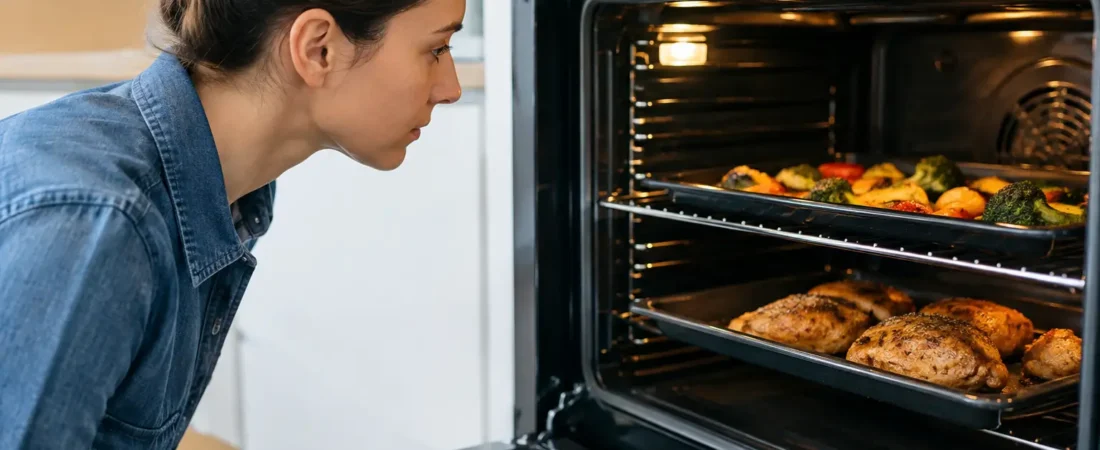
A sheet pan of cookies that browns on one side and stays pale on the other is more than a baking frustration. Homeowners often ask what causes oven uneven heating when recipes that once worked suddenly produce inconsistent results. The answer may be as simple as rack placement or as involved as a failing heating element, temperature sensor, convection fan, or electronic control.
An oven does not hold every inch of its cavity at precisely the same temperature. Small temperature swings are normal, especially while the oven cycles its heat source on and off. The concern is a persistent pattern: food burns in one area, takes much longer to cook on one rack, or remains underdone despite a correct preheat time. Finding the pattern helps narrow down the fault before replacing parts.
What Causes Oven Uneven Heating Most Often?
Uneven heating can come from the way heat is produced, circulated, measured, or allowed to escape. The appliance type matters. An electric oven typically relies on bake and broil elements, while a gas oven uses a burner and ignition system. A convection model adds a fan and, on many models, a separate ring-shaped heating element around that fan.
A weak or damaged bake element
In a conventional electric oven, the lower bake element does much of the work during baking. If it is cracked, blistered, visibly burned, or only heating intermittently, the oven may preheat slowly and leave cooler areas in the cavity. Some elements can fail without obvious exterior damage, so a visual inspection is useful but not conclusive.
A broil element that does not cycle correctly can also affect temperature recovery and browning. Modern ovens often use both elements in varying cycles, even when the selected mode says Bake. That is why replacing a part based only on its location can lead to the wrong repair.
A failing convection fan or convection element
Convection cooking depends on air movement. A fan that is noisy, slow, obstructed, or not running at all cannot distribute heat as designed. Food may cook unevenly from front to back, and pans on separate racks may perform very differently.
Not every fan should run continuously. Some ovens cycle the fan or delay it during preheat, depending on the selected setting. A technician verifies fan operation under the correct cooking mode rather than assuming a brief pause means the fan has failed.
An inaccurate oven temperature sensor
The temperature sensor tells the control board when to add or reduce heat. If the sensor drifts out of range or its wiring is damaged, the displayed temperature may not match the actual cavity temperature. An oven set to 350°F may run consistently low, high, or fluctuate more widely than expected.
This problem can look like uneven heating when it is actually an overall temperature issue. For example, a casserole may be done around the outside but cool in the center simply because the oven never reached the selected temperature. Sensor testing requires checking its electrical resistance and comparing the result with the manufacturer’s specifications.
Door gasket, hinges, or door alignment problems
A worn gasket allows heat to escape around the oven door. Heat loss is often most noticeable near the front of the oven, causing food at the rear to cook more quickly. Loose hinges or a door that does not sit squarely can create a similar issue, even when the gasket looks intact.
Look for flattened, torn, hardened, or loose sections of gasket. Do not use the oven if the door will not close properly or if excessive heat is escaping into the kitchen. Beyond poor cooking results, sustained heat loss can strain nearby controls and cabinetry.
Restricted airflow and poor rack placement
Sometimes the oven is functioning normally, but the cookware arrangement prevents heat from moving around food. Oversized roasting pans, foil placed across racks, and tightly packed baking sheets can block circulation. Foil should never cover the oven floor unless the manufacturer specifically allows it, because it can reflect heat toward components and interfere with airflow.
Rack position also matters. A pan too close to the lower element can scorch on the bottom, while food near the top may brown too fast under an active broil element. When baking several pans, leave space between them and avoid placing one pan directly over another unless the recipe calls for it. Rotate pans halfway through only when the recipe allows it, since repeated door opening lowers oven temperature.
Gas burner or ignition issues
In a gas oven, uneven heat may come from a burner that does not ignite promptly or does not produce an even flame pattern. A weak igniter can glow but still fail to draw enough current to open the gas valve reliably. The burner may light late, cycle poorly, or provide insufficient heat.
A burner with blocked ports can also create localized hot and cool areas. Because gas appliances involve combustion and fuel supply, burner, valve, and igniter diagnosis is best left to a qualified appliance technician. If you smell gas, turn off the appliance if it is safe to do so, leave the area, and follow your gas provider’s emergency guidance.
Control board or relay failures
The electronic control board directs power to elements, fans, and, in some designs, the gas ignition circuit. A failing relay can cause an element to remain off too long, heat continuously, or operate inconsistently. This fault can be intermittent, which makes it especially frustrating for homeowners: one meal turns out correctly, while the next does not.
Control board diagnosis should follow testing of simpler parts such as the elements, sensor, wiring connections, and door seal. Boards are expensive on many premium models, so replacing one without confirming the failure is rarely a good first step.
How to Confirm Uneven Oven Heating
Start with a simple, repeatable test. Place identical slices of white bread on a light-colored baking sheet and bake them at a moderate temperature for a short period. Watch for consistent browning differences from side to side or front to back. This test will not provide an exact temperature reading, but it can reveal a useful heat pattern.
A digital oven-safe probe thermometer or multiple probes provide more reliable information than a basic dial oven thermometer. Inexpensive dial thermometers can react slowly and may be inaccurate themselves. For a meaningful check, let the oven preheat fully, then record temperatures over several heating cycles rather than judging it at one moment.
While testing, make sure the oven is empty except for the test pan or probes. Remove heavy cookware, foil, pizza stones, and stored pans that may alter airflow or heat retention. Check whether the issue appears in Bake, Convection Bake, Broil, or every setting. That detail is valuable when arranging service.
Repairs Homeowners Can Safely Start With
Before inspecting anything, turn off power at the breaker for an electric oven. For a gas range, avoid disassembly of fuel-system components. Once the appliance is cool, clean spills from the cavity and inspect the door gasket for obvious tears or sections that have pulled loose. Confirm that racks are installed correctly and that no cookware is blocking vents.
Avoid attempting to straighten an element, bypass a door switch, or continue using an element that is sparking, cracked, or visibly damaged. Likewise, do not use the self-clean cycle to solve a heating problem. The extreme heat can place added stress on components that may already be failing.
If your model has a temperature calibration adjustment in its settings, use it cautiously. Calibration can help when the oven is consistently a small amount high or low, but it will not repair a weak element, damaged sensor, faulty fan, or poor door seal. Large errors and uneven results call for diagnosis rather than repeated adjustment.
When Professional Oven Service Makes Sense
Professional service is appropriate when the oven trips the breaker, shows an error code, preheats slowly, has a damaged element, fails to run its convection fan, or produces a gas odor. It is also the practical choice when a premium appliance such as Wolf, Miele, Thermador, Viking, Bosch, or KitchenAid is cooking inconsistently. These ovens may use model-specific sensors, control programming, and airflow systems that require accurate testing.
For homeowners and property managers in Miami-Dade and Broward County, King Appliances can diagnose whether uneven results come from a component failure, an airflow issue, or a normal limitation of the cooking setup. A proper diagnosis checks the full heating system instead of replacing the most visible part first.
A reliable oven should make dinner feel predictable again. If changing pan placement and clearing airflow do not improve the results, stop guessing at the cause and have the temperature, heating components, and door seal tested before a minor issue becomes a failed cooking appliance.