A cake that browns too quickly on top, cookies that need an extra ten minutes, or a roast that finishes later than expected can all point to the same question: is the oven actually reaching the temperature on the display? Oven temperature calibration can help, but it is not always the right first answer. Many ovens heat in cycles, and an inaccurate thermometer, failing sensor, weak heating element, or damaged door gasket can create symptoms that an adjustment alone will not fix.
For homeowners, tenants, and property managers, the goal is not to make an oven thermometer show one perfect number every second. The goal is to confirm that the oven maintains a reasonable average temperature and cooks food consistently. That distinction matters when deciding whether to change a calibration setting or schedule a repair.
What Oven Temperature Calibration Actually Does
Oven temperature calibration changes the oven’s temperature offset. If an oven regularly averages 15 degrees low when set to 350°F, an offset may instruct the control to heat a little longer or cycle differently so the average moves closer to 350°F. Depending on the model, this option may be called calibration, temperature adjustment, temperature offset, or oven adjustment.
It does not repair a component that is failing. If the temperature sensor is inaccurate, the bake element is weak, the control board relay is sticking, or heat is escaping through a worn gasket, a calibration setting may hide the problem temporarily while baking performance continues to decline.
Calibration procedures also vary widely by brand and model. Some GE, Whirlpool, KitchenAid, Frigidaire, Samsung, LG, Bosch, Thermador, Wolf, Viking, and Miele ovens allow an adjustment through the control panel. Other models require a specific button sequence, and some should be adjusted only through service diagnostics. The owner’s manual for the exact model is the proper reference before changing any setting.
Why a Single Oven Thermometer Reading Can Mislead You
Most electric and gas ovens do not heat continuously. They cycle above and below the selected temperature to maintain an average. At a 350°F setting, the air temperature may rise above 350°F, then drop below it before the oven turns the heat back on. Opening the door, placing a cold casserole inside, and using convection all affect that cycle.
An inexpensive dial thermometer placed on one rack records only the air temperature around that spot. It may respond slowly, be inaccurate itself, or sit in a hot or cool zone. This is why an oven that briefly reads 325°F or 375°F is not automatically out of calibration.
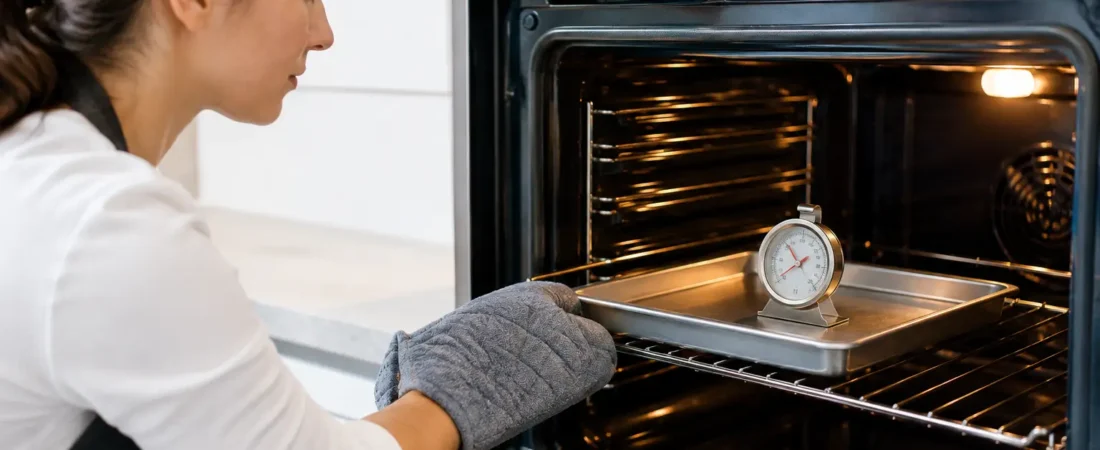
A more useful check takes time. Preheat the empty oven to 350°F and allow it to cycle for at least 20 to 30 minutes after the preheat signal. Place a reliable oven thermometer near the center of the middle rack, away from the walls. Record several readings over another 20 minutes instead of relying on the first number you see.
If the readings average close to the selected temperature and cooking results are normal, no adjustment is usually needed. A small variation is expected. A repeated average difference of roughly 15 to 25 degrees, especially when food is consistently underdone or overdone, deserves closer attention.
Test Baking Can Be More Informative Than a Thermometer
A simple test bake often reveals what an air thermometer cannot. Bake a familiar recipe on the center rack at the recommended temperature and time. Note whether the food cooks evenly, whether the bottom or top browns first, and whether the oven takes unusually long to preheat.
For example, pale cookies with overly dark bottoms may indicate a rack-position issue, an overly aggressive lower element, or a dark pan before it indicates a general temperature problem. Food that is underdone in the center but burns at the edges may point to uneven heat circulation. The pattern matters as much as the temperature reading.
Common Problems That Look Like Calibration Issues
Before changing an offset, look for conditions that can alter oven performance. A door gasket that is torn, flattened, loose, or coated with heavy residue can allow heat to escape. The oven may seem slow, run frequently, or heat the kitchen more than usual.
In an electric oven, a bake or broil element can be damaged even if it still gets hot. A weak element may heat slowly, cycle inconsistently, or produce uneven results. Visible blistering, cracks, sparking, or areas that do not glow during operation are warning signs. Do not continue using an element that sparks or arcs.
The oven temperature sensor is another common source of trouble. This thin probe is usually mounted inside the rear wall of the oven cavity. The control board relies on its resistance reading to manage heat. If the sensor drifts out of range, the oven may overheat, underheat, display an error code, or fluctuate excessively.
Electronic controls can also fail. A relay that does not switch correctly may leave an element on too long or prevent it from receiving full power. On gas ovens, ignition and burner problems can cause delayed ignition, weak flame patterns, or incomplete heating. These are repair issues, not calibration issues.
Convection ovens add another variable. A malfunctioning fan can produce hot and cool areas even if the average temperature is correct. If one side of a sheet pan browns much faster than the other, or food near the rear cooks differently from food near the door, airflow should be considered.
When a Calibration Adjustment Makes Sense
A calibration adjustment is reasonable when the oven is otherwise operating normally: it preheats, cycles, has no error codes, heats evenly, and consistently averages slightly high or low across repeated tests. It is best to make a modest adjustment, then repeat the same test bake.
Avoid making a large correction based on one meal or one thermometer reading. Adjusting the setting by 25 or 35 degrees to compensate for a faulty sensor can make the oven unpredictable and complicate later diagnosis. If your model permits adjustment, changes in 5- to 10-degree increments are easier to evaluate.
Also consider the recipe before blaming the appliance. Dark metal pans, glass bakeware, silicone mats, oversized cookware, crowded racks, and opening the door frequently can all change cooking results. Recipes written for conventional heat may need different timing or temperature in convection mode.
When to Stop Troubleshooting and Arrange Service
Turn the oven off and seek professional help if it overheats significantly, smells of burning wiring, sparks, trips a breaker, displays persistent error codes, or has a damaged element. A gas oven that smells strongly of gas, has delayed ignition, or shows an irregular flame should not be treated as a calibration project.
Professional diagnosis is also sensible when an oven is more than about 25 degrees off after repeated testing, cannot maintain a stable average, or cooks unevenly despite proper rack placement and cookware. Testing sensors, elements, wiring, relays, and electronic controls often requires electrical measurements with the appliance disconnected from power. That work is safer and more reliable when performed by a qualified technician.
In South Florida, built-in and premium ovens may also be installed in tight cabinetry or condominium kitchens where access is limited. King Appliances can diagnose temperature-control concerns on major and premium appliance brands across Miami-Dade and Broward County, including whether a calibration adjustment is appropriate or whether a failed component is the real cause.
Keep Temperature Problems From Becoming Bigger Repairs
Keep the oven cavity reasonably clean, especially around the door opening and gasket. Heavy grease buildup can smoke during heating and make it harder to notice a genuine electrical odor. Do not line the oven floor, racks, or vents with foil unless the manufacturer specifically allows it, since foil can interfere with airflow and reflect excessive heat toward components.
Use the center rack for most temperature testing and baking, and avoid storing heavy pans inside the oven where they can strike the sensor or obstruct airflow. If cleaning the gasket, use a soft cloth and mild cleaner rather than pulling or scrubbing it aggressively.
An oven does not need to display a perfectly fixed temperature to bake well. What it needs is a stable, repeatable heat pattern. If your tests show a small, consistent difference, calibration may be the answer. If the readings swing widely, heat unevenly, or come with warning signs, treating the underlying repair early is the better way to protect both the appliance and the meals you rely on it to cook.