
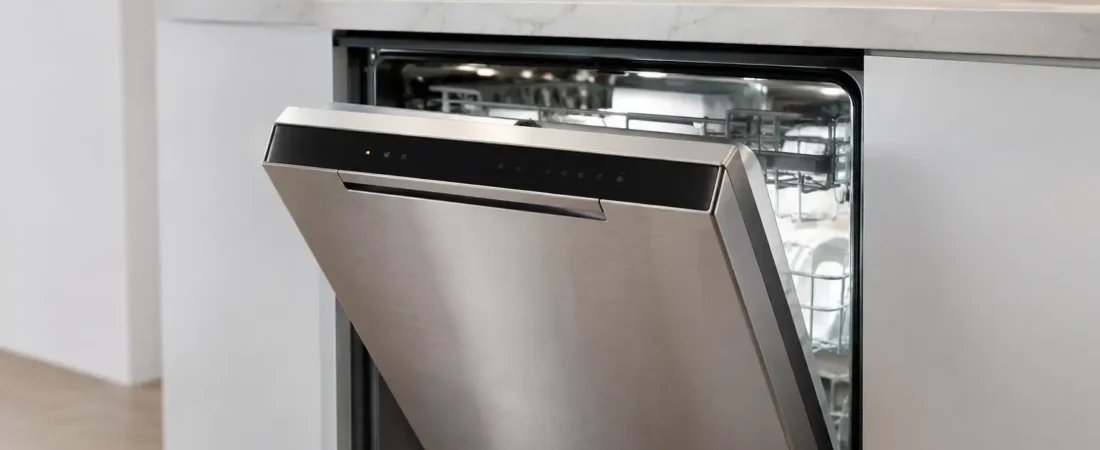
A Miele display code can narrow down a dishwasher problem quickly, but it rarely identifies one failed part with certainty. Miele dishwasher error codes are fault indicators, not complete diagnoses. A blocked filter, a kinked hose, a failing pump, a wiring issue, or a control problem can sometimes produce similar symptoms.
That distinction matters with premium dishwashers. Resetting the machine may clear a temporary alert, but it does not correct a recurring drainage, water-intake, heating, or leak condition. Before arranging service, homeowners can safely check a few accessible items. Beyond that point, accurate diagnosis usually requires testing components and confirming the code against the dishwasher’s specific model.
How to Read Miele Dishwasher Error Codes
Miele has used different control platforms over the years, so code definitions and display wording can vary by model and market. Some units show an F-number, while others provide a message such as “Waterproof system,” “Check water intake,” or “Drain.” The owner’s manual for the exact model remains the best reference for the wording on that display.
If a code appears once after a power interruption or an interrupted cycle, turn the dishwasher off, wait a few minutes, and restart it once. If it returns, write down the exact code, when it appears, and what the dishwasher was doing at the time. For example, a fault that occurs during the first few minutes points in a different direction than one that appears near the end of the cycle.
Do not repeatedly restart a dishwasher that is leaking, making grinding noises, tripping a breaker, or displaying a waterproof-system fault. Shut off the dishwasher and its water supply if water is present around the unit.
Common Miele Dishwasher Fault Codes
F11: Drainage Fault
F11 is commonly associated with a drainage problem. The dishwasher has not emptied water within the expected time, or it cannot confirm that the tub is draining properly. This is one of the more common service calls because the cause may be simple, but it can also involve a failing drain pump.
Start by removing the lower rack and checking the filter assembly and sump area for food debris, broken glass, labels, bones, or small utensils. Clean the filters under running water and make sure the drain pump cover and nearby area are free of obstructions, following the instructions for the model. Also inspect the visible drain hose under the sink for sharp bends or crushing.
If the dishwasher still holds water after those checks, the issue may be a worn drain pump, blockage farther down the hose, a restriction at the sink connection, or an electrical fault. Avoid using chemical drain cleaners in the dishwasher. They can damage internal components and create a hazardous service condition.
F12 or F13: Water Intake Problems
F12 and F13 are generally related to water entering the dishwasher too slowly or not entering as expected. Depending on the model, the machine may stop early in the cycle, display a water-intake message, or run without beginning normal washing action.
First, make sure the shutoff valve under the sink is fully open and that the home has normal water pressure at nearby fixtures. Check that the inlet hose is not kinked or pinched behind the dishwasher. If the dishwasher has an accessible inlet screen, it may need cleaning, but only after the water supply is shut off.
In South Florida, mineral buildup can gradually affect screens and valves, especially where water conditions and usage patterns vary. However, low flow is not always the answer. A defective water inlet valve, faulty flow meter, wiring issue, or control-board problem may create the same code. A technician should test these parts rather than replace them by guesswork.
F14: Circulation or Pressure Monitoring Fault
An F14 fault is often connected to circulation performance or pressure monitoring. The dishwasher may fill with water but fail to wash normally, and the spray arms may not move as they should. A clogged filter or debris in the circulation area can contribute, but this code can also indicate a problem with the circulation pump, pressure switch, heater-pressure system, or related electronics.
Check that the filters are clean and that the spray arms can rotate freely. Remove visible debris from the tub, but do not dismantle internal pump components without the proper procedure. Circulation assemblies in Miele dishwashers are integrated systems, and incorrect reassembly can cause leaks or additional faults.
F24: Heating Relay or Heater Circuit Fault
F24 is commonly tied to the heater relay or heating circuit. The dishwasher may complete a cycle with poor drying, unusually long run times, or cold wash water. Because this can involve high-voltage electrical components and the electronic control, it is not a homeowner repair.
A technician will typically inspect wiring connections, test the heater circuit, and evaluate the control board and relay function. Turning the dishwasher off and on may clear the display temporarily, but a recurring F24 deserves prompt professional evaluation. Continued operation can lead to incomplete cleaning and may place additional stress on electrical components.
F51: Pressure Switch or Water-Level Monitoring Fault
F51 often points to a pressure-switch or water-level sensing issue. The dishwasher relies on pressure information to manage filling, circulation, heating, and draining. Residue in the pressure system, a restricted hose, a failed sensor, or an electrical connection issue may trigger the code.
This fault is a good example of why a code should not be treated as a part number. Replacing a pressure switch without checking the associated hoses, circulation conditions, and wiring may not solve the problem. Professional testing is usually the practical next step.
F70: Waterproof System Activated
F70 is a serious fault because it generally means the dishwasher has detected water in its base pan or an activated leak-protection system. The machine may run a drain pump continuously and refuse to start a normal cycle.
Turn off the dishwasher and close the water supply valve. Do not keep resetting the code or tip the appliance to drain it. Water in the base can come from a loose connection, damaged hose, leaking pump seal, door seal issue, dispenser leak, or internal component failure. The visible water is often the result, not the source, of the problem.
A proper repair involves locating the leak, correcting it, drying the base safely, and verifying that the dishwasher can operate through a full cycle without another leak event.
F78: Circulation Pump Fault
F78 is frequently associated with the circulation pump or its communication and control circuit. Typical symptoms include a dishwasher that fills and drains but does not spray water, unusual humming, or a cycle that stops shortly after starting.
Clean filters and check for obvious debris first. If the unit continues to show F78, the repair may require pump testing, electrical checks, or diagnosis of the control system. Because Miele circulation pumps can be costly, confirming the root cause before replacing parts is especially valuable.
When a Reset Is Reasonable and When It Is Not
A single restart can be reasonable after checking the filter, confirming the water valve is open, or correcting a pinched hose. It is not a repair strategy for an error that returns. Repeated resets can mask a developing leak, pump failure, or heating issue and may leave dishes sitting in contaminated water.
Stop using the dishwasher and arrange service sooner if there is standing water that will not drain, a burning odor, a breaker trip, visible leaking, repeated F70 warnings, or loud mechanical noise. Tenants should also notify the property owner or manager before attempting anything beyond basic filter cleaning.
Preventing Repeat Dishwasher Faults
Regular filter cleaning is the most useful preventive step for most households. How often depends on use and what goes into the dishwasher, but monthly inspection is a sensible starting point. Scrape heavy food from dishes, keep labels and small items out of the tub, and occasionally inspect the drain hose and sink connection for restrictions.
For seasonal residences in Miami-Dade and Broward County, run the dishwasher periodically rather than leaving it unused for long stretches. Before closing a home for an extended period, clean the filters, check for signs of moisture beneath the unit, and consider shutting off the dishwasher water supply if appropriate for the property.
When a Miele code keeps returning, precise diagnosis protects both the appliance and the kitchen around it. King Appliances can help homeowners in areas such as Hollywood, Aventura, Hallandale Beach, and Fort Lauderdale identify the actual cause and make repairs based on testing, not assumptions.